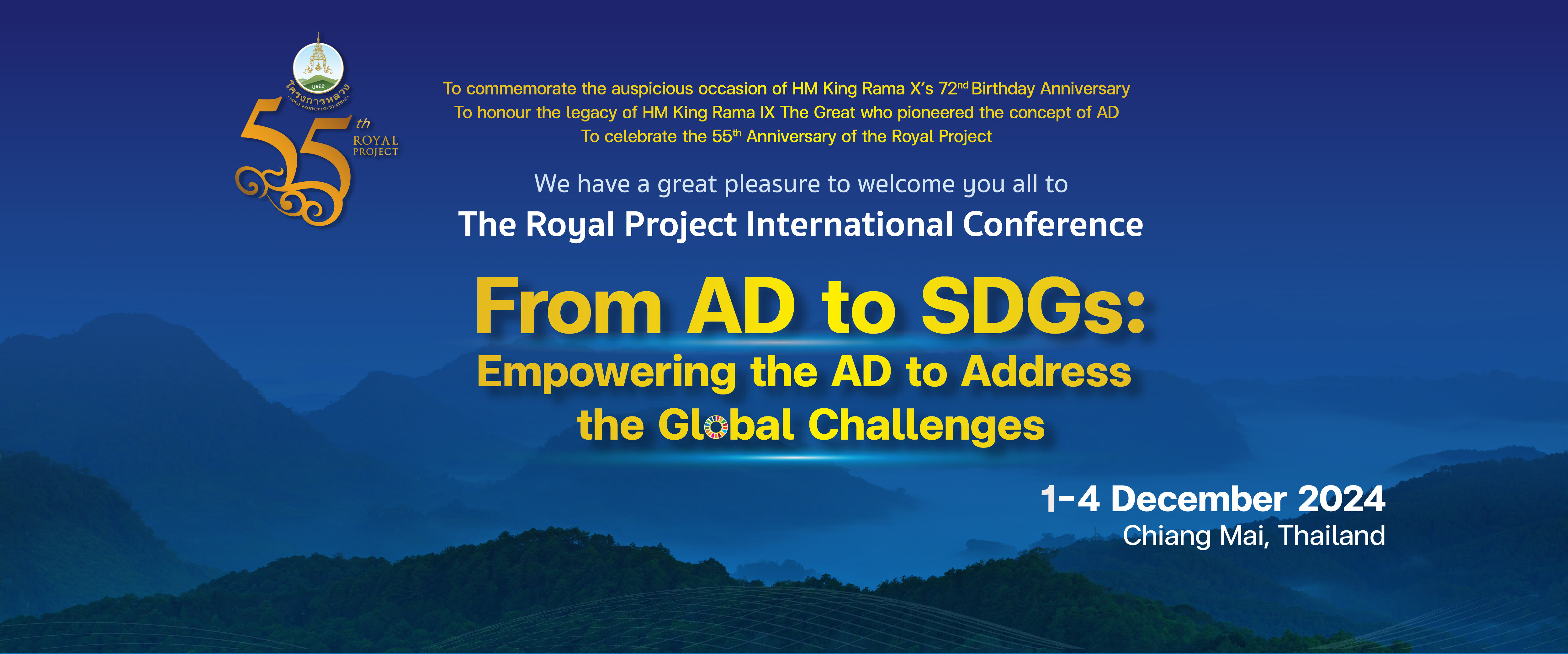
“From Alternative Development (AD) to Sustainable Development Goals (SDGs): Empowering Alternative Development to Address Global Challenges”
1 – 4 December 2024, Chiang Mai, Thailand
Pursuant to the resolution entitled “Celebrating the tenth anniversary of the United Nations Guiding Principles on Alternative Development: effective implementation and the way forward” (CND 67/3) adopted at the 67th session of the Commission on Narcotic Drugs (CND), the Royal Project Foundation and the Government of Thailand will host the International Conference on the theme “From Alternative Development (AD) to Sustainable Development Goals (SDGs): Empowering Alternative Development to Address Global Challenges” during 1-4 December 2024 in Chiang Mai, Thailand.
Looking back in the past 50 years, the highland remote communities in Thailand and its neighbouring countries have encountered common challenges, including illicit crops cultivation in particular opium poppies, deforestation and limited access to basic infrastructure. In response to these challenges, the Royal Project, initiated by His Majesty King Bhumibol Adulyadej The Great, applied an alternative development concept, by introducing new cash crops to improve quality of life of highland people, preserving watershed forests, and promoting water and soil conservation. These efforts have raised highland communities’ quality of life and alleviated from poverty. This legacy has further guided by His Majesty King Maha Vajiralongkorn Phra Vajiraklaochaoyuhua’s royal command to nurture, conserve, and extend for the benefit and happiness of the people.
However, today’s challenges have become more complex. Illicit drug production and trafficking are rapidly evolving, with the emerging challenges of synthetic drugs. The increase in mono cropping agriculture, and utilisation of synthetic fertilisers, insecticides and bactericides, have deteriorated soil quality and the overall environment, coupled with climate change, extreme weathers, and climate-driven phenomenon such as droughts, soil infertility, erratic and intense rainfall patterns, floods, and emerging insect pests. These are at the heart of the challenges impacting the realisation of Sustainable Development Goals (SDGs). For alternative development to remain relevant in this complex environment, it is necessary to explore new dimensions, which could assist states in addressing emerging challenges and achieving SDGs.
1) To share success stories on the application of alternative development in addressing poverty and hunger, illicit crop cultivation and environmental degradation, leading to a dignified and sustainable way of life for highland communities.
2) To share best development practices, taking into account social, economic and environmental aspects, as well as human development and humanitarian actions, carried out in particular by the Royal Project in Thailand. These practices are dedicated to enhance well-being, social security, stability and equality of the people.
3) To share knowledge and experiences in applying alternative development approach to tackle challenges in various contexts. Three field visits will be arranged to Le Tor Royal Project Development Centre, Ang Khang Royal Project Agriculture Research Station, and Pa Pae Highland Development Project, in commemoration of the auspicious occasion of His Majesty King Maha Vajiralongkorn Phra Vajiraklaochaoyuhua's 72nd Birthday Anniversary (King Rama X) and honouring the profound legacy of His Majesty King Bhumibol Adulyadej The Great (King Rama IX) who pioneered the concept of sustainable alternative development.
4) To encourage participants to jointly analyse lessons learned on the implementation of alternative development projects and programmes, and how these alternative development practices can contribute to formulate effective strategies to help states address global challenges and expediting progress towards the achievement of Sustainable Development Goals (SDGs).
Sustainable development can only be achieved through collective efforts. Realising Sustainable Development Goals (SDGs) requires cross-cutting actions from all parts of the society. We need to take lessons learned and share good practices with other countries to enable us to explore all aspects that alternative development can offer. This will help us build resilience in the changing world and international cooperation is indispensable. The discussion will be organised in three panels.
Panel 1: Shaping Today's Value from Past Experiences – Our planet currently faces complex and interconnected challenges. “A Looking Back to Go Forward” aims to gather success stories in driving substantive change over the past decades, as well as lessons learned of where we have failed. This will critically contribute to how we can shape today’s value and move forward to achieve sustainability.
Panel 2: Cultivating Tomorrow Sustainability from Past and Present Journey – Pursuing sustainable development is a journey that embraces the spirit of finding the right pathways that enable a good life for all, leaving no one behind, while safeguarding the environment for future generations. The lessons learned from the past and present are a source of wisdom and guidance, a tool we can use to make better decisions in the future.
Panel 3: Voices from the Unheard – To ensure successful practice of alternative development that truly leads to sustainable development, governments have to foster local communities’ engagement, listen to their needs and empowering them to drive meaningful and lasting changes and create a future where every voice is heard.
Three successful highland community development examples, implemented by the Royal Project Foundation (RPF) and the Highland Research and Development Institute (Public Organization) (HRDI), are selected to showcase the operation in highland areas in Thailand. These three operation areas illustrates concrete and successful implementation of alternative development models from Thailand.
Participants of the Conference are invited to join one of field visits. Details as follows:
Group 1: Ang Khang Royal Project Agriculture Research Station
Angkhang is situated in remote valley that straddles the Thai-Myanmar border. It is the first Royal Project Agriculture Research Station, which was founded by His Majesty King Bhumibol Adulyadej The Great in 1969.
The objective was to eradicate opium cultivation in Northern Thailand, provide alternative means for highland people to gain income with a view to alleviate poverty, as well as reforestation. Angkhang has been
utilised as a research and development station for cultivating various types of temperate crops, including vegetables, fruit trees and flowers. The project’s focus is to encourage hill tribe farmers to cultivate
these plants for financial gain rather than relying on opium for income. Currently, the Angkhang communities are opium-free. The villagers live in a more balanced way and in harmony with the nature.
Group 2: Le Tor Royal Project Development Centre
The success of the Royal Project Model led to its expansion to the Le Tor Royal Project Development Centre in Tak Province, the 39th Development Centre and marking the first Centre during King Rama X’s reign.
In 2016, the area was the last remaining illegal opium cultivation area in Thailand due to its remoteness, the lack of a transportation route, and the difficult access. Within eight years of operation,
opium cultivation was eradicated. The project has significantly enhanced the local community's quality of life, with access to basic infrastructure necessary for their living and work.
Group 3: Pa Pae Highland Development Project
Pa-Pae community in Chiang Mai Province was heavily reliant on Miang (native tea) reforestation as their primary source of income. However, when the price of Miang plummeted, without any alternative occupation,
they faced income insufficiency, leading to household debt. The Highland Research and Development Institute (Public Organisation) (HRDI) introduced a novel approach to assist the community in generating income
while sustainably preserving natural resources and taking into account the evolving global context. The villagers were encouraged to adopt a conservation system where they cultivated Miang trees alongside other crops.
Coffee was grown under the shade of the Miang forest, and various alternative crops were promoted for income generation. As a result, the average household income in Pa-Pae increased significantly. This accomplishment not only raised awareness within the community about the importance of conserving forests, but also motivated villagers to actively engage in sustainable forest conservation. The operation in Pa Pae highlights the cooperation and coordination between the community and government agencies, whilst contributing to global efforts to preserve nature and combat climate change and its impact.
Alternative development has increasingly been recognised as a strategy to address the world drug problem. The alternative development programmes are introduced to promote licit crops cultivation primarily to address poverty and lack of livelihood opportunities, which are, in most cases, and among others, root causes of illicit drug crop cultivation.
Bearing in mind emerging complex challenges, the conference can serve as a platform for discussion and exchange of view on how alternative development can be a tool towards building a more inclusive and sustainable society, and achieving the 2030 Agenda for Sustainable Development Goals. The forward-looking alternative development strategies and programmes should be able to, but not limited to,