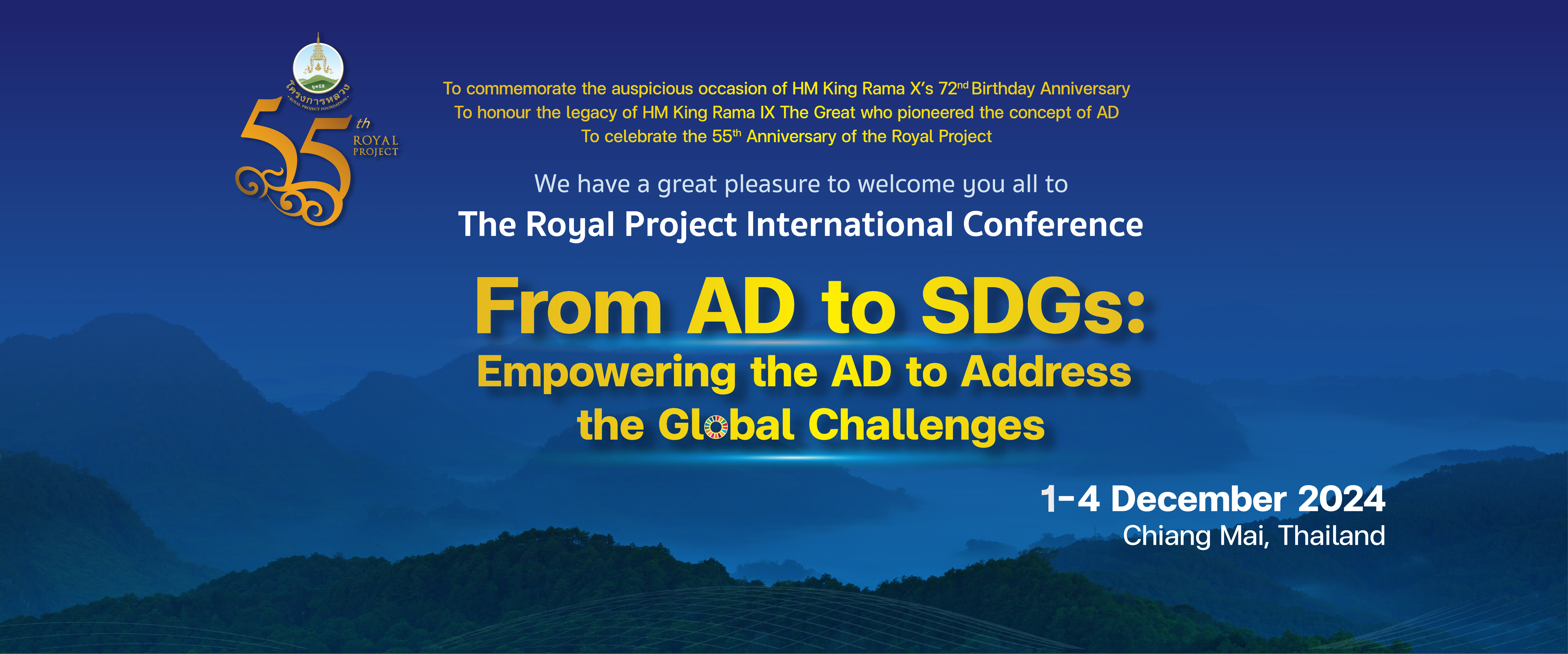
“From Alternative Development (AD) to Sustainable Development Goals (SDGs): Empowering Alternative Development to Address Global Challenges”
1 – 4 December 2024, Chiang Mai, Thailand
| Sunday, 1 December 2024 | |
|---|---|
| 20:00 hrs. (TBC) | Gala Dinner |
| Monday, 2 December 2024 | |
|---|---|
| Keynote Session | |
| 09:00 – 09:30 hrs. | Royal Project’s 55-Year Journey and the Way Forward, H.E. Privy Council General Kampanat Ruddit, Secretary-General of the Royal Project Foundation (RPF) and Chairman of the RPF Executive Board - The Royal Project Sustainable Highland Alternative Development Model has applied alternative development (AD) model in addressing poverty-stricken highland communities by developing essential infrastructure, tackling economic and social inequality, improving education and public health, and creating economic opportunity for the people, while meeting new challenges. |
| 09:30 – 09:45 hrs. | Doi Tung Development Project’s 36-Year Experience from Opium Cultivation and Deforestation to Sustainable Development Khunying Puangroi Diskul Na Ayutthaya, Board Member of Mae Fah Luang Foundation - Over 36 years, the Doi Tung Development Project has transformed a community that once relied on opium cultivation into one that is self-reliant, stable, and drug-free through the idea of “Helping people to help themselves”. |
| 09:45 – 10:00 hrs. | A Flourishing Alliance: The Royal Project of Thailand and the Royal Project of Bhutan Mr. Karma Tenzin, Deputy Chamberlain, Focal Point, the Royal Project of Bhutan - The Royal Project of Thailand and the Royal Project of Bhutan have been cooperating since 2003. The two countries exchanged valuable knowledge through various technical cooperation activities, which drew out ideas from the respective country’s wisdom – namely the Sufficiency Economy Philosophy of Thailand (SEP) and the Gross National Happiness (GNP) of Bhutan. |
| 10:00 – 10:15 hrs. | UNODC Perspective on AD in line with Sustainable Development Goals Representative from UNODC (TBC) - Alternative Development was introduced as a means to reduce and eliminate illicit drug cultivation. However, the root cause of drug cultivation stemmed from many factors. To comprehensively address the root causes and those factors, this session will discuss and aim to look forward on how can AD be utilised to address all dimensions of drug problems in the global arena. |
| 10:15 – 10:30 hrs. | Bringing Sustainability to Highland Areas Mr. Jong-Jin Kim, Assistant Director General and FAO Regional Representative for Asia and the Pacific - For many parts of the world, highland and mountainous regions are contributing to food security and environmental sustainability. However, highlands in many regions are the most susceptible to problems such as poverty, irregular migration, and natural disaster. We must look ahead and think about what can be done to ensure development whilst assist them in adapting to challenges. |
| 10:30 – 10:45 hrs. | Coffee break |
| 10:45 – 11:00 hrs. | Four Decades of Poverty Reduction in China: A Chinese Success Story and What’s Next? H.E. Mr. Han Zhiqiang, Ambassador Extraordinary and Plenipotentiary of the People's Republic of China to the Kingdom of Thailand - China has been successful in reducing the number of people living in extreme poverty and has built a “moderately prosperous society in all respects”. The question now is what is China’s plan to address new challenges and leave no one behind. |
| 11:00 – 11:15 hrs. | Reflections on How International Collaboration Contributes towards Sustainability Mr. Timo Menniken, Country Director for GIZ Thailand - International collaboration is a crucial component in attaining sustainability. GIZ, as a major player in the international development field, is a great example of how we can and should collaborate in order to achieve sustainable development goals. |
| 11:15 – 11:30 hrs. | Driving Policy Coherence for Sustainable Development Former Minister for Agriculture and Cooperatives (2014-2015), and former Permanent Secretary, Ministry of Agriculture and Cooperatives (1998-2003) - To ensure the success of sustainable development programmes, government shall have long-term political and financial commitments to ensure that local communities are involved in development programmes. |
| 11:30 – 11:45 hrs. | Challenges in the Fight Against Synthetic Drugs Pol. Lt. Gen. Panurat Lakboonto, Secretary-General, the Office on Narcotic Control Board (ONCB) - The ONCB has been fighting against drug issues and has taken many approaches, including the AD. Despite the efforts, there are still many challenges to overcome, especially in today’s context which drug markets expanded and technologies have led to increased drug production in many regions in the world. |
| 11:45 – 12:00 hrs. | Joint efforts on Knowledge and Best Practices Sharing to Achieve Sustainable Development Director-General, the Thailand International Cooperation Agency (TICA) - As one of Thailand’s main focal points for international development cooperation, TICA has many insightful experiences and stories on sustainable development cooperation which could serve as a good example. |
| 12:00 – 13:30 hrs. | Lunch |
| Panel Discussion: Yesterday's Milestones for Wisdom of Today and Tomorrow | |
| 13:30 – 14:30 hrs. | Panel Discussion I - Shaping Today's Value from Past Experiences
- Our world today is full of many challenges and threats affecting all of us. To be able to navigate through these challenges, we should start by looking back at lessons we learnt. Our successes and failures will teach us and help us shape today’s direction in moving forward, including with the underlining values which embrace sustainability for better future. |
| 14:30 – 15:30 hrs. | Panel Discussion II – Cultivating Tomorrow Sustainability from Past and Present Journey
Sustainable Development is key in pursuit of alleviating living quality of our people and safeguarding the planet for the future generations. The lessons learned will provide wisdom and guidance in making better decisions for the future. |
| 15:30 – 15:45 hrs. | Coffee break |
| 15:45 – 17:00 hrs. | Panel Discussion III – Voices from the Unheard Farmers from:
- In order to achieve a sustainable future, no one shall be left behind. This panel will highlight the voices of the most vulnerable groups that are often left unheard. |
| 17:00 – 17:15 hrs. | Business arrangement |
| 17:15 – 18:00 hrs. | Visit of the Royal Park Rajapruek |
| 18:00 – 20:00 hrs. | Welcome Reception |
| Tuesday, 3 December 2024 | |
|---|---|
| 08:00 – 17:00 hrs. | Site Visit Group 1 – Angkhang Royal Project Agriculture Research Station, Chiang Mai Province - Angkhang Royal Project Agriculture Research Station is the first Royal Project Agriculture Research Station founded in 1969. The establishment of this research station was to prevent hill tribe farmers from cultivating opium, by providing them with alternative crops for farming. Today, Angkhang is opium-free and is a great example of where locals live in harmony with nature. Group 2 – Le Tor Royal Project Development Centre, Tak Province - Le Tor is the 39th and latest Royal Project Development Centre. Prior to its establishment, the area was still filled with opium farming due to its remoteness. Soon after the Royal Project came in, eradicated opium cultivation, provided the locals with alternative crops to cultivate, which has improved quality of life of the people. The locals have adopted environment-friendly farming methods and live in harmony with nature. Group 3 – Pa Pae Highland Development Project, Chiang Mai Province - Formerly a community that once relied on Miang (a type of native tea) as their source of income. The local community was then faced with lack of income when the price of Miang plummeted. The Highland Research and Development Institute (HDRI) then introduced an alternative approach that encourages locals to grow other types of crops alongside Miang and also promotes sustainable practices. This resulted in an increase in household income and also help the community to realise the importance of preserving the environment. |
| Wednesday, 4 December 2024 | |
|---|---|
| 09:00 – 12:00 hrs. | Reflection on Alternative Development in Action |
| 09:00 – 10:00 hrs. | Part I - Presentations by Group 1 – Group 3 site visits
|
| 10:00 – 10:15 hrs. | Coffee break |
| 10:15 – 12:00 hrs. | Part II - Reflection cont’d - Representatives from each of the three site visit groups will present key points drawn from and suggestion on the implementation of alternative development in each site and suggestion, if any. Later on, participants will examine strengths, weaknesses, opportunities and threat (SWOT) of existing alternative development approach. The goal of the discussion is to ensure that alternative development remains relevant and continue to help address the myriads of challenges that are presented in the world. |
| 12:00 – 12:30 hrs. | Summary of the International Conference Closing ceremony |
| 12:30 – 13:30 hrs. | Lunch |
| Afternoon | City excursion / Departure of delegates |
| Thursday, 5 December 2024 | |
|---|---|
| Morning/Afternoon | Departure of delegates |